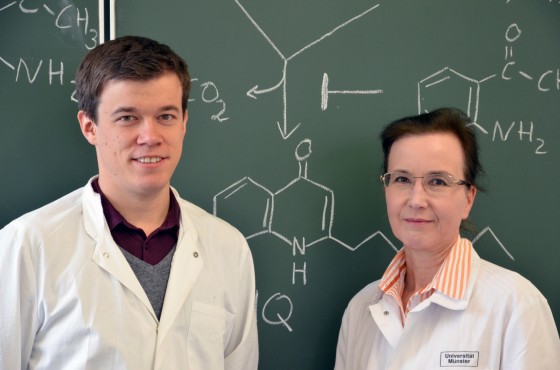
Doctoral student Steffen Drees and Susanne Fetzner
- WWU/Franziska Birmes
So-called hospital germs are a big worry for physicians and hygiene specialists as these bacteria can spell danger for people with a weakened immune system. This is especially true when the germs are resistant to one or more antibiotics and surround themselves with a so-called biofilm as a sort of protective shield. Microbiologists at the Universities of Münster and Nottingham, in England, have now analysed an enzyme which might play an important role in the treatment of infections from the hospital germ Pseudomonas aeruginosa . They have decoded the three-dimensional structure of the enzyme and revealed its function. Their work has been published in the latest issue of the Journal of Biological Chemistry and has been given prominence as "Paper of the Week". This special honour is awarded to a maximum of 100 articles among the 6,600 and more that are published in the Journal every year. The Pseudomonas aeruginosa bacterium is the fourth most common pathogen worldwide causing hospital-acquired infections.
TO READ THIS ARTICLE, CREATE YOUR ACCOUNT
And extend your reading, free of charge and with no commitment.