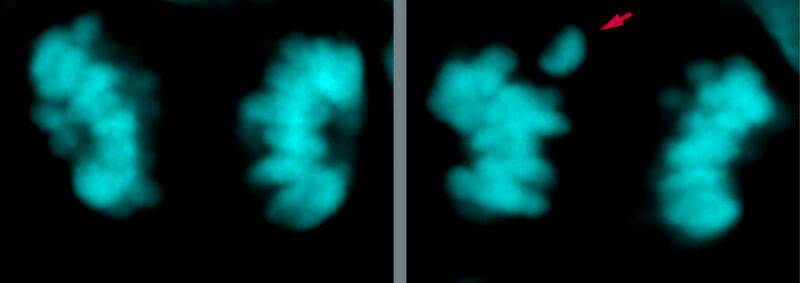
 Fewer chromosome segregation errors in modern human than Neanderthal neural stem cells. Left side: microscopy image of the chromosomes (in cyan) of a modern human neural stem cell of the neocortex during cell division. Right side: same type of image, but of a cell where three amino acids in the two proteins KIF18a and KNL1, involved in chromosome separation, have been changed from the modern human to the Neanderthal variants. These ’neanderthalized’ cells show twice as many chromosome separation errors (red arrow).
Brain stem cells of modern humans make fewer mistakes in the distribution of their chromosomes to the daughter cells. Fewer chromosome segregation errors in modern human than Neanderthal neural stem cells. Left side: microscopy image of the chromosomes ( in cyan ) of a modern human neural stem cell of the neocortex during cell division. Right side: same type of image, but of a cell where three amino acids in the two proteins KIF18a and KNL1, involved in chromosome separation, have been changed from the modern human to the Neanderthal variants. These 'neanderthalized' cells show twice as many chromosome separation errors (red arrow). Felipe Mora-Bermúdez / MPI-CBG - Neanderthals are the closest relatives to modern humans. The neocortex, the largest part of the outer layer of the brain, is unique to mammals and crucial for many cognitive capacities.
TO READ THIS ARTICLE, CREATE YOUR ACCOUNT
And extend your reading, free of charge and with no commitment.
Your Benefits
- Access to all content
- Receive newsmails for news and jobs
- Post ads