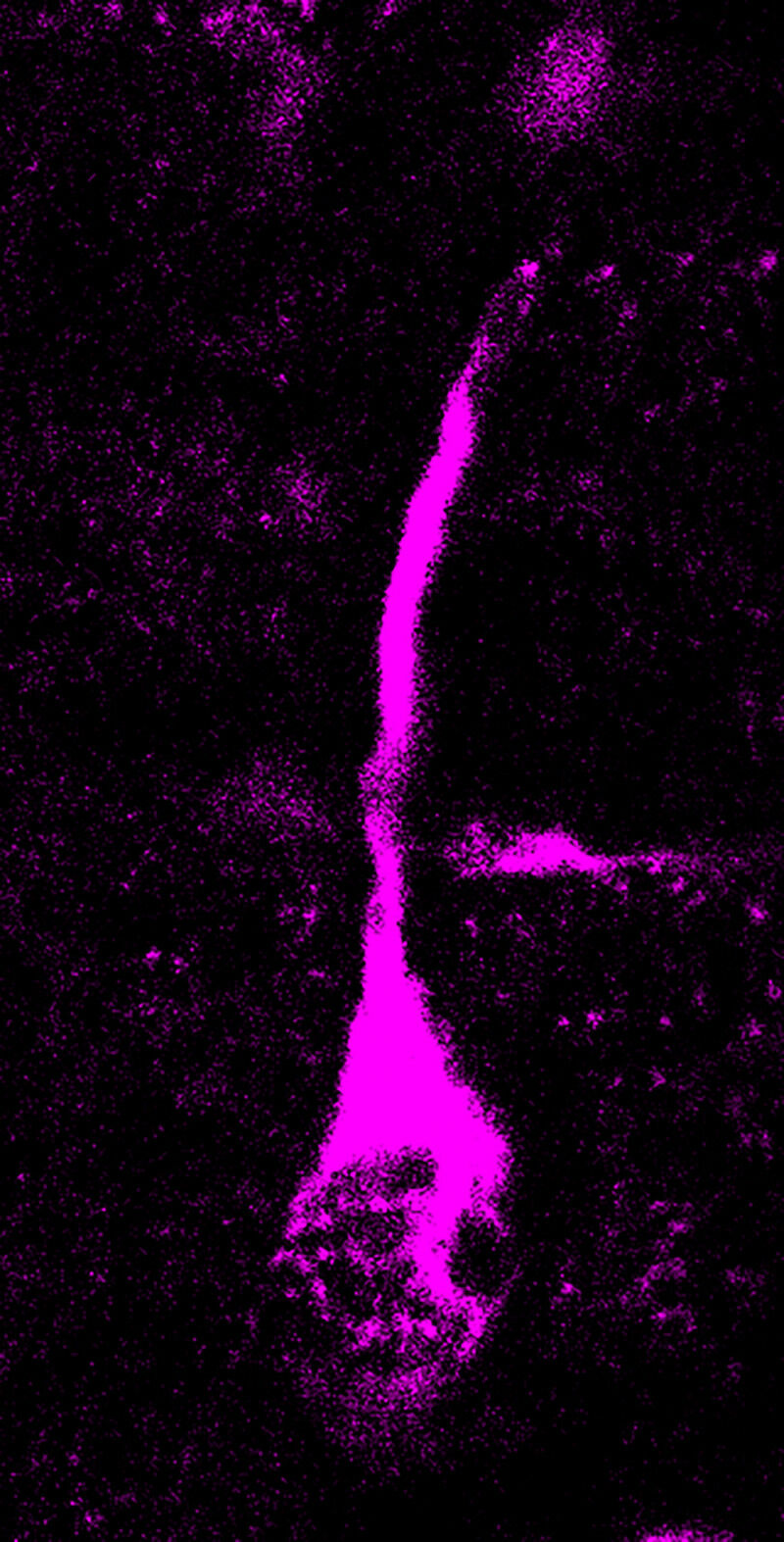
 Microscopy picture of a dividing basal radial glial cell, a progenitor cell type that generates neurons during brain development. Modern human TKTL1, but not Neandertal TKTL1, increases basal radial glia and neuron abundance.
Due to the change of a single amino acid, brain evolution has proceeded differently. Microscopy picture of a dividing basal radial glial cell, a progenitor cell type that generates neurons during brain development. Modern human TKTL1, but not Neandertal TKTL1, increases basal radial glia and neuron abundance. Pinson et al. Science 2022 / MPI-CBG - While both Neandertals and modern humans develop brains of similar size, very little is known about whether modern human and Neandertal brains may have differed in terms of their neuron production during development. Researchers from the Max Planck Institute of Molecular Cell Biology and Genetics (MPI-CBG) in Dresden now show that the modern human variant of the protein TKTL1, which differs by only a single amino acid from the Neandertal variant, increases one type of brain progenitor cells, called basal radial glia, in the modern human brain. Basal radial glial cells generate the majority of the neurons in the developing neocortex, a part of the brain that is crucial for many cognitive abilities.
TO READ THIS ARTICLE, CREATE YOUR ACCOUNT
And extend your reading, free of charge and with no commitment.
Your Benefits
- Access to all content
- Receive newsmails for news and jobs
- Post ads