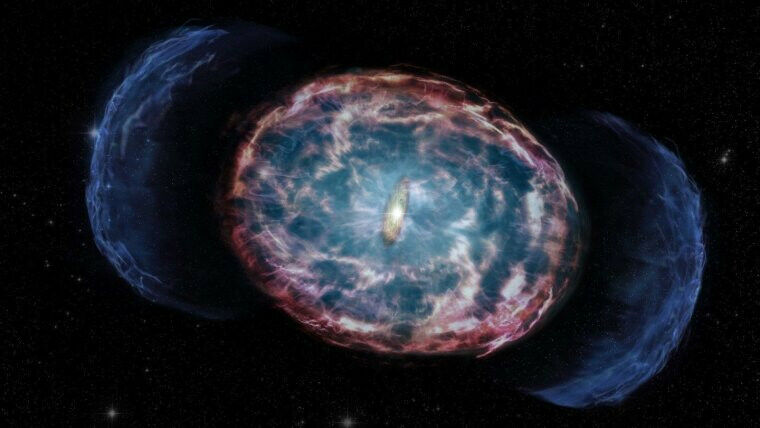
Artist’s conception of a kilonova, which occurs after the merger of neutron stars. Picture: M. Weiss/CfA
Artist's conception of a kilonova, which occurs after the merger of neutron stars. Picture: M. Weiss/CfA - An international research team is investigating the aftermath of a gigantic cosmic burst with the help of NASA's "Chandra" X-ray observatory. Theoretical physicists from the University of Jena are supporting the researchers by providing detailed predictions and simulations to enable interpretation of Chandra's X-ray data. The team published its findings in the scientific journal "Astrophysical Journal Letters". Astronomers may have detected a "sonic boom" from a powerful blast known as a kilonova. This event was seen in GW170817, a merger of two neutron stars and the first object detected in both gravitational waves and electromagnetic radiation, or light. A kilonova occurs when two neutron stars - some of the densest objects in the universe - merge.
TO READ THIS ARTICLE, CREATE YOUR ACCOUNT
And extend your reading, free of charge and with no commitment.