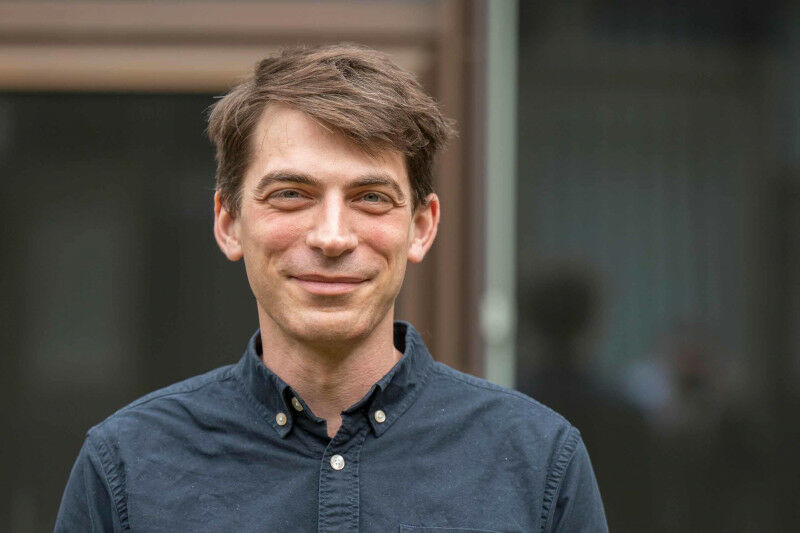
Malte Rosemeyer’s project ’Experimental Replication of Historical Reanalysis Processes’ received an ERC Consolidator Grant. Image Credit: Bernd Wannenmacher
Malte Rosemeyer's project 'Experimental Replication of Historical Reanalysis Processes' received an ERC Consolidator Grant. Image Credit: Bernd Wannenmacher - How did verbs such as "to go," which were originally reserved for describing specific actions, come to take on the more abstract grammatical role of signifying the future (for example, "voy a cantar" in Spanish, or "I am going to sing" in English)- And why did this happen not just once, but across multiple languages? Why did this change in meaning occur in many Romance languages, but not in German? And how can complex cognitive and social processes that took place hundreds of years ago, such as changes in what a word can be used to express, be researched in a meaningful way? In historical linguistics, reanalysis is described as a process by which speakers assign a new meaning to a superficially unchanged element. Reanalysis presents several methodological difficulties for researchers in the field of historical linguistics. For example, evidence of language change is often determined by comparing language use over time across different historical texts. Reanalysis, however, is a cognitive process and its existence is thus very difficult to prove using written texts. Analyzing language usage in historical texts can only provide limited information about the conditions under which reanalysis takes place. The EXREAN project is the first of its kind to systematically examine reanalysis and actualization processes in a laboratory setting.
UM DIESEN ARTIKEL ZU LESEN, ERSTELLEN SIE IHR KONTO
Und verlängern Sie Ihre Lektüre, kostenlos und unverbindlich.