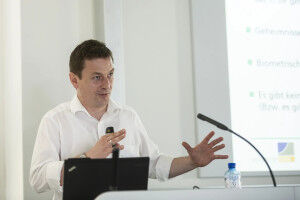
Philipp Mittendorfer with the artificial skin for robots "Cellul.A.R.Skin" (Image: Astrid Eckert / TUM)
The current episode of "Horizons" on BBC World News focuses on technology inspired by nature - including sensitive artificial skin developed by Philipp Mittendorfer at TUM's Institute for Cognitive Systems. On the show, he explains how research with the so-called Cellul.A.R.Skin is opening the way for humanoid, industrial, and service robots to work safely with people in shared environments. Watch video : "Artifical Skin - Teaching robots to feel" (5'14 min. BBC World News, Horizons The current version of the artificial skin makes robots so sensitive they not only avoid potentially harmful contact but can even be guided with a feather. The circuitry and algorithms behind it can easily be integrated into other approaches, ranging from traditional system-on-chip technology to printed organic semiconductors. .
TO READ THIS ARTICLE, CREATE YOUR ACCOUNT
And extend your reading, free of charge and with no commitment.