An alloy of aluminum, magnesium and scandium is strong and does not become brittle even when exposed to relatively large amounts of hydrogen
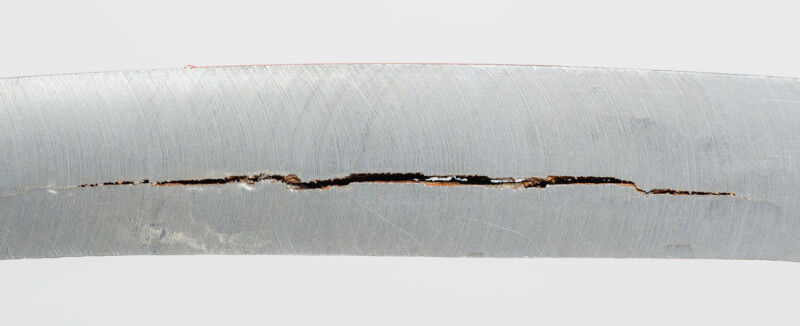
Aluminum alloys are known for their light weight and corrosion resistance - properties that make them ideal materials for a CO2-free economy. Whether in the lightweight construction of vehicles or as storage tanks for green hydrogen, the demand for aluminum will continue to increase with the transition to sustainable technologies. However, one major obstacle to this is hydrogen embrittlement: Aluminum tends to become brittle on contact with hydrogen - cracks form and eventually lead to fractures in the material. Hydrogen-resistant alloys were previously too soft to be used for high-tech applications. An international research team - including scientists from the Max Planck Institute for Sustainable Materials - has now found a solution to this problem: They are pursuing a new approach to develop alloys that are particularly strong and at the same time resistant to embrittlement. This enables them to make various aluminum alloys fit for the hydrogen industry. They have published their research results in the journal Nature.
Nanoparticles capture hydrogen and increase strength
The team has produced an alloy that contains scandium, a rare earth metal, as well as aluminum and magnesium. The scientists used a two-stage heat treatment to create nanoparticles of aluminum and scandium in the alloy. Some of the particles, which are larger than about ten nanometers in diameter, are enclosed in a shell of aluminium, magnesium and scandium. Both types of particles are distributed throughout the aluminum-magnesium alloys and fulfill two important functions: the smaller particles of aluminum and scandium increase the strength, while the particles with the shell of aluminum, magnesium and scandium bind hydrogen and thus make the material more robust against hydrogen embrittlement. -Until now, we had to choose between a high-strength alloy or a hydrogen-resistant alloy," says Baptiste Gault, head of a research group at the Max Planck Institute for Sustainable Materials. -Our new strategy combines both for the first time
Until now, we had to choose between a high-strength alloy or a hydrogen-resistant alloy. Our new strategy combines both for the first time.
Professor Baptiste Gault, head of the Atomic Probe Tomography Group and one of the corresponding authors of the study
The new alloy therefore has about 40 percent higher strength and five times higher resistance to hydrogen embrittlement than an aluminum-magnesium alloy without scandium. Even if quite a lot of hydrogen penetrates the alloy, it remains ductile and does not form cracks.
Researchers at the Max Planck Institute for Sustainable Materials created an essential basis for the development of the new alloy in a study published in 2022. In it, they used atom probe tomography, among other things, to clarify how exactly hydrogen leads to the embrittlement of aluminum and how nanoparticles embedded in the material can trap and defuse the hydrogen. The Max Planck researchers have now also used atom probe measurements to prove that the nanoparticles with the aluminum, magnesium and scandium shell bind the hydrogen. Their measurements thus confirmed that the new approach to alloy design works.
From the lab to industry
Particularly promising: the researchers also transferred the new design to other aluminum alloys and achieved comparable improvements. In addition, they successfully tested the manufacturing process under industrially relevant conditions. -Our results show that this strategy not only works in the laboratory, but is also suitable for industrial applications," says Baptiste Gault.
Our results show that this strategy not only works in the laboratory, but is also suitable for industrial application.
The new design for aluminum alloys could thus make an important contribution to the safety and longevity of infrastructure in a hydrogen economy.
The research work was carried out in collaboration with scientists from Xi-an Jiaotong University (China) and Shanghai Jiao Tong University (China).
Yasmin Ahmed Salem