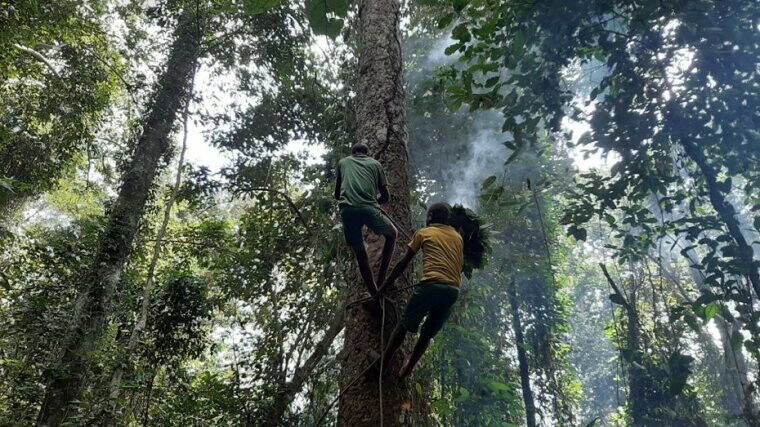
Collective honey foraging by two teenage boys. Here they use a technique in which they smoke the bee hives to avoid getting stung. Image: Bryndan van Pinxteren
Collective honey foraging by two teenage boys. Here they use a technique in which they smoke the bee hives to avoid getting stung. Image: Bryndan van Pinxteren - A new study, published in the journal Frontiers in Ecology and Evolution, investigated the foraging behaviour of children in a present-day forager society. Already from an early age, there was a gender-specific development of foraging skills. These new findings, combined with the high level of food sharing in forager societies, support the embodied capital theory, offering an explanation for the substantially larger brains in humans. Foraging skills could have provided humans with a more stable energy and nutrient supply, which may ultimately have enabled large resource investments into the brain. The research was led by the University of Amsterdam (UvA), the German Centre for Integrative Biodiversity Research (iDiv), the Max Planck Institute for Evolutionary Anthropology, the Helmholtz Centre for Environmental Research (UFZ), and the Friedrich Schiller University Jena.
TO READ THIS ARTICLE, CREATE YOUR ACCOUNT
And extend your reading, free of charge and with no commitment.