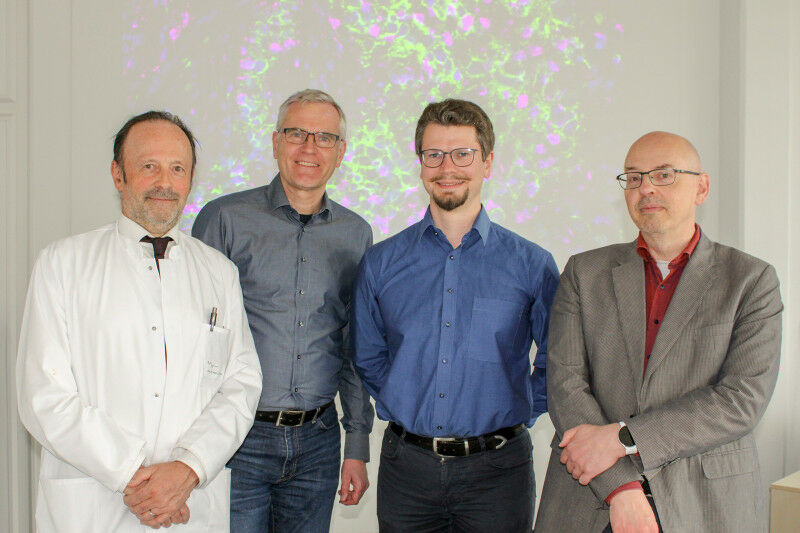
You can find a photo here. It shows, from left, Professor Dr. Joachim Krauss, Professor Dr. Herbert Hildebrandt, Dr. Hauke Thiesler and Christian Hartmann in front of the image of an immunostained sectional preparation from a glioblastoma. The polysialic acid on the surface of the tumour cells (green) in contact with the tumour-associated macrophages (TAM, magenta) can be seen. The nuclei of the cells are coloured blue. Copyright: Maike Isfort / MHH
You can find a photo here. It shows, from left, Professor Dr. Joachim Krauss, Professor Dr. Herbert Hildebrandt, Dr. Hauke Thiesler and Christian Hartmann in front of the image of an immunostained sectional preparation from a glioblastoma. The polysialic acid on the surface of the tumour cells ( green ) in contact with the tumour-associated macrophages (TAM, magenta ) can be seen. The nuclei of the cells are coloured blue. Copyright: Maike Isfort / MHH - Feature combination of Siglec-16 and polysialic acid increases survival in patients with glioblastoma Glioblastomas are malignant brain tumours with a poor prognosis because they usually do not respond to common cancer therapies. One reason for this is that the tumour cells have developed mechanisms to evade immune defence. Even more: certain cells of the innate immune system, so-called tumour-associated macrophages (TAM), are influenced in such a way that they not only do not attack the tumour cells, but even stimulate tumour growth.
TO READ THIS ARTICLE, CREATE YOUR ACCOUNT
And extend your reading, free of charge and with no commitment.