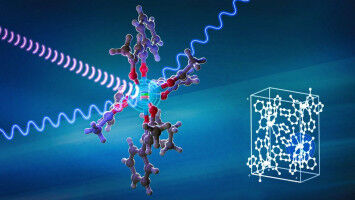
Example of deep photonic artificial intelligence: Multiple layers of thin scatterers of light represent a complex, deep convolutional neural network (CNN) which is the neural network architecture of choice for most visual computing applications.
Example of deep photonic artificial intelligence: Multiple layers of thin scatterers of light represent a complex, deep convolutional neural network (CNN) which is the neural network architecture of choice for most visual computing applications. Eileen Otte, AP, WWU In a recent nature perspective, international experts in the field of optical neural networks, optical deep learning and photonic computing have put their expertise together to review the path from pathbreaking optical neural networks and optical computing realizations in the past fifty years and how they advanced to photonic artificial intelligence applications. The team, which includes the physicist Prof. Cornelia Denz from the Institute of Applied Physics at the University of Münster, discusses also promises and challenges for future deep optics and photonics and its next-generation applications in knowledge representation, learning, planning and perception. Artificial intelligence - the intelligence demonstrated by machines - is a central topic in today's society. Ranging from autonomously operating cars over strategic game an optimization systems up to understanding human speech, they all have in common that they act as "intelligent agents? that perceive its environment and takes actions that maximize its chance of success or of achieving a certain goal. Many of these tasks require huge data set for learning or processing and thus at the same time fast and low-power execution. Here, optics come in to play.
UM DIESEN ARTIKEL ZU LESEN, ERSTELLEN SIE IHR KONTO
Und verlängern Sie Ihre Lektüre, kostenlos und unverbindlich.
Ihre Vorteile
- Zugang zu allen Inhalten
- Erhalten Sie Newsmails für Neuigkeiten und Jobs
- Anzeigen veröffentlichen