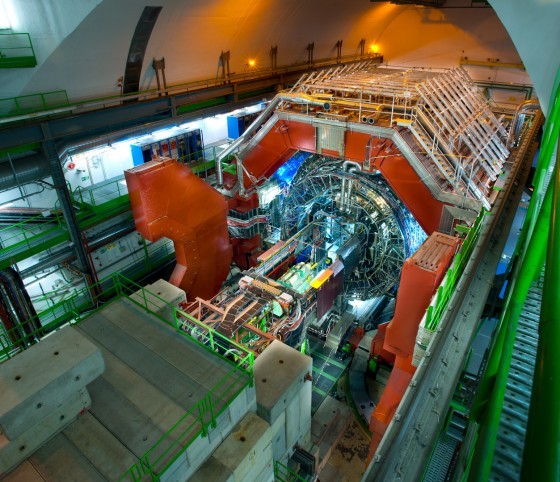
 Das Experiment ALICE am Teilchenbeschleuniger LHC
New findings published in ''Nature' on the formation of matter / Experiments provide information on the beginnings of the universe. The building blocks of matter in our universe were formed in the first 10 microseconds of its existence, according to the currently accepted scientific picture. After the Big Bang about 13.7 billion years ago, matter consisted mainly of quarks and gluons, two types of elementary particles whose interactions are governed by quantum chromodynamics (QCD), the theory of strong interaction. In the early universe, these particles moved (nearly) freely in a quark-gluon plasma. Then, in a phase transition, they combined and formed hadrons, among them the building blocks of atomic nuclei, protons and neutrons. In the current issue of the science journal "Nature", an international team of scientists presents an analysis of a series of experiments at major particle accelerators which sheds light on the nature of this transition. The scientists determined with precision the transition temperature and obtained new insights into the mechanism of cooling and freeze-out of the quark-gluon plasma into the current constituents of matter such as protons, neutrons, and atomic nuclei.
UM DIESEN ARTIKEL ZU LESEN, ERSTELLEN SIE IHR KONTO
Und verlängern Sie Ihre Lektüre, kostenlos und unverbindlich.
Ihre Vorteile
- Zugang zu allen Inhalten
- Erhalten Sie Newsmails für Neuigkeiten und Jobs
- Anzeigen veröffentlichen