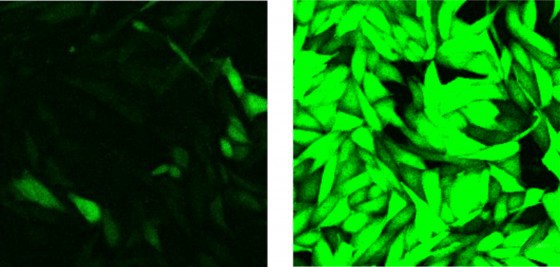
 With a normal supply of oxygen, the newly developed reporter used by the Münster scientists is inactive, so only a few cells can be detected under the microscope (left). If there is a drop in the oxygen supply, the reporter causes the cells affected to light up green (right).
Without oxygen, cells cannot survive. If the oxygen supply drops, for example due to a heart attack, long-term damage may result. However, just how serious such damage really is can only be assessed hours or even days later. For the first time now, and using light microscopy, scientists in Münster have observed reduced oxygen supply directly in individual cells. This was technically not feasible before, because there was no possibility to indicate an acute lack of oxygen using so-called reporters. Such a reporter was now developed by a research team led by Prof. Friedemann Kiefer and Prof. Michael Schäfers as part of the Cells-in-Motion Cluster of Excellence (CiM) and Collaborative Research Centre 656, "Molecular Cardiovascular Imaging" at Münster University. The reporter, consisting of protein, encoded by a special DNA molecule, a so-called DNA construct, works in such a way that fluorescent molecules are produced in cell with insufficient oxygen.
TO READ THIS ARTICLE, CREATE YOUR ACCOUNT
And extend your reading, free of charge and with no commitment.
Your Benefits
- Access to all content
- Receive newsmails for news and jobs
- Post ads