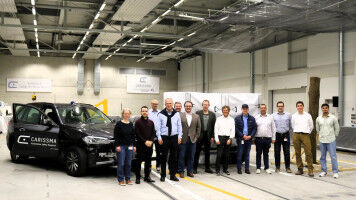
Automated vehicles that move independently through traffic are increasingly conquering the roads. However, they are not yet able to move safely and accident-free regardless of traffic conditions and without a driver to intervene in an emergency. The Thuringian Innovation Center for Mobility at the Technical University of Ilmenau wants to make autonomous vehicles safer and road traffic more efficient with its new research group "Bistatic radar signatures of traffic objects as a link between environment detection and mobile communication (BiRaUM)".
Prof. Thomas Dallmann has a realistic vision: automated vehicles that recognize their surroundings with absolute reliability and exchange all’information quickly and precisely with each other - accidents are avoided and traffic flows more smoothly. Mobility of the future means getting from A to B safely, quickly, and comfortably. To achieve this, the BiRaUM research group led by Prof. Dallmann is making use of radio and radar signals, as these are reflected by objects in our environment.
The key question facing Prof. Dallmann’s team is: How do communication and radar systems perceive road users and objects, and how can this be measured accurately and efficiently? "In order to move safely in traffic, vehicles must be able to recognize a variety of different objects in their environment: other cars, cyclists, and pedestrians, but also road signs, trees, guardrails, and buildings. The more data available from different types of sensors and different road users, the safer it is. With a new generation of radio-based vehicle communication, we want to make this possible."
With 6G, the mobile communications technology expected to be launched around 2030, this vision is set to become reality. In addition to existing services such as mobile internet and traffic networking, 6G will also offer sensing functions to detect the environment, similar to a radar system. However, the technology, which experts call "Integrated Communications and Sensing" (ICAS for short), requires a precise understanding of how objects are perceived by the systems. The research group aims to find an answer to this question.
To this end, the Thuringian Innovation Center for Mobility ( ThIMo ) provides a unique infrastructure for mobility research. At its heart is the recently inaugurated "BiRa bistatic radar reflectivity measurement system." As part of the "Virtual Road - Simulation and Test Facility VISTA," it can be used to measure reflectivity in the vehicle environment. The biggest problem here is that capturing all large and complex objects in the environment completely, and at millimeter intervals, takes weeks or even months with conventional methods due to the enormous amount of data involved. The new research group is now developing a completely new measurement method that allows the reflection of such objects to be characterized precisely, yet quickly. So that a self-driving car brakes as soon as a child’s ball rolls onto the road.