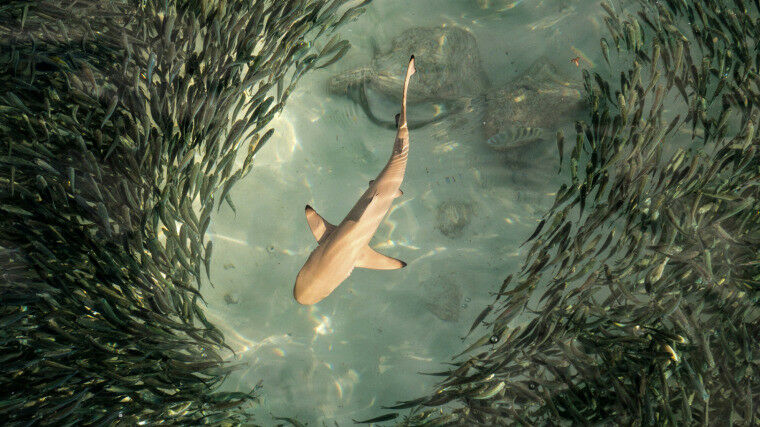
Dangerous food search: A swarm of fish meets a blacktip reef shark. Image: Oliver Krüger
Dangerous food search: A swarm of fish meets a blacktip reef shark. Image: Oliver Krüger - Meta-analysis shows that in animals, difficult living conditions increase risk-taking behaviour in later life Life The lives of animals in the wild are full of risky situations with uncertain outcomes. Whether they are exploring new habitats in unfamiliar terrain or searching for new food sources, they run the risk of being caught and killed by a predator. In many instances, their very survival depends on a single decision. Whether an animal decides to take a risk or prefers to avoid danger varies greatly from one individual to another. " Just as there are humans who are more cautious and others who take more risks, among animals of a particular species there are also individuals that are more or less risk-averse ," says population ecologist Prof. Holger Schielzeth of the University of Jena. These differences are to some degree innate, but to a considerable extent they also depend on an individual's development.
TO READ THIS ARTICLE, CREATE YOUR ACCOUNT
And extend your reading, free of charge and with no commitment.