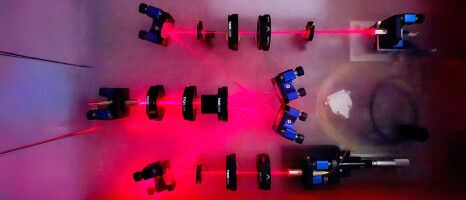
If the spins of phosphorus atoms in silicon are cleverly excited with microwave pulses, a so-called spin echo signal can be detected after a certain time. Surprisingly, this spin echo does not occur only once, but a whole series of echoes can be detected. Image: C. Hohmann / MCQST
If the spins of phosphorus atoms in silicon are cleverly excited with microwave pulses, a so-called spin echo signal can be detected after a certain time. Surprisingly, this spin echo does not occur only once, but a whole series of echoes can be detected. Image: C. Hohmann / MCQST - If the spins of phosphorus atoms in silicon are cleverly excited with microwave pulses, a so-called spin echo signal can be detected after a certain time. Surprisingly, this spin echo does not occur only once, but a whole series of echoes can be detected. Multiple echoes as a result of a strong link between spins and microwave photons - A team of researchers from the Technical University of Munich (TUM), TU Wien (Vienna University of Technology) and the Bavarian Academy of Sciences and Humanities have discovered a remarkable echo effect - this effect presents exciting, new opportunities for working with quantum information. Small particles can have an angular momentum that points in a certain direction - this is known as spin. This spin can be manipulated using a magnetic field.
UM DIESEN ARTIKEL ZU LESEN, ERSTELLEN SIE IHR KONTO
Und verlängern Sie Ihre Lektüre, kostenlos und unverbindlich.